Exploration of Priestia flexa for the Biosynthesis of Polyhydroxybutyrate (PHB) and Comprehensive Evaluation of its Biodegradation Potential under Different Environmental Conditions
S. H. Ganesha
Department of Post Graduate Studies and Research in Microbiology, Bioscience Complex, Jnanasahyadri, Kuvempu University, Shankaraghatta – 577451, Karnataka, India.
Nandish G *
Department of Post Graduate Studies and Research in Microbiology, Bioscience Complex, Jnanasahyadri, Kuvempu University, Shankaraghatta – 577451, Karnataka, India.
*Author to whom correspondence should be addressed.
Abstract
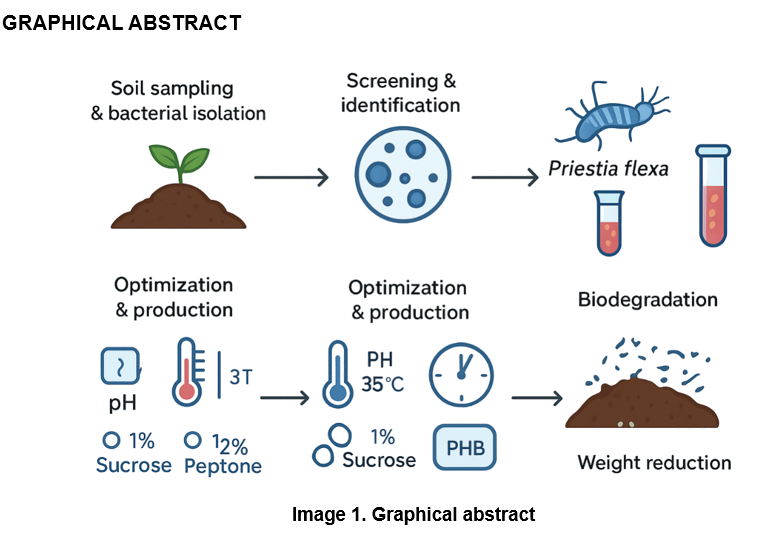
Biodegradable alternatives are required due to the increasing environmental impact of synthetic polymers. Although production costs and yields limit its industrial use, polyhydroxybutyrate (PHB), a microbial polyester with thermoplastic and biocompatible qualities, is a viable possibility. In this study, resilient PHB-producing bacteria were isolated from industrial soils, the biodegradation capability of PHB was assessed, and cultural conditions were optimized for improved PHB synthesis. Soil samples from the industrial region of Goraguntepalya, Bangalore, were processed via serial dilution, yielding four isolates. PHB 2 showed the largest intracellular concentration among the two PHB-positive strains found by Sudan Black B staining. 16S rRNA sequencing, morphological analysis, and biochemistry all confirmed that PHB 2 was Priestia flexa (GenBank accession: OR462711.1). 1.13 g of PHB per 300 mL of broth was the greatest amount of PHB that could be produced using the following conditions: 48 hours of incubation, pH 7.0, 35 °C, 0.5% NaCl, 1% sucrose, and 1% peptone. The typical absorption peak at 250 nm in UV-visible spectroscopy verified PHB. Biodegradation assays demonstrated weight loss of 0.08% after 5 days in rhizosphere soil, confirming PHB’s microbial degradability. These results highlight P. flexa as a promising bioplastic producer with potential for sustainable applications. Using agro-industrial wastes as carbon substrates, enhancing yields through metabolic engineering, and carrying out extended biodegradation experiments in various environments are some future objectives. When combined, these tactics have the potential to hasten PHB's shift to environmentally benign, scalable plastic replacements.
Keywords: Biodegradable plastic, biopolymer optimization, environmental sustainability, microbial biopolymer, microbial degradation, Priestia flexa, plastic pollution